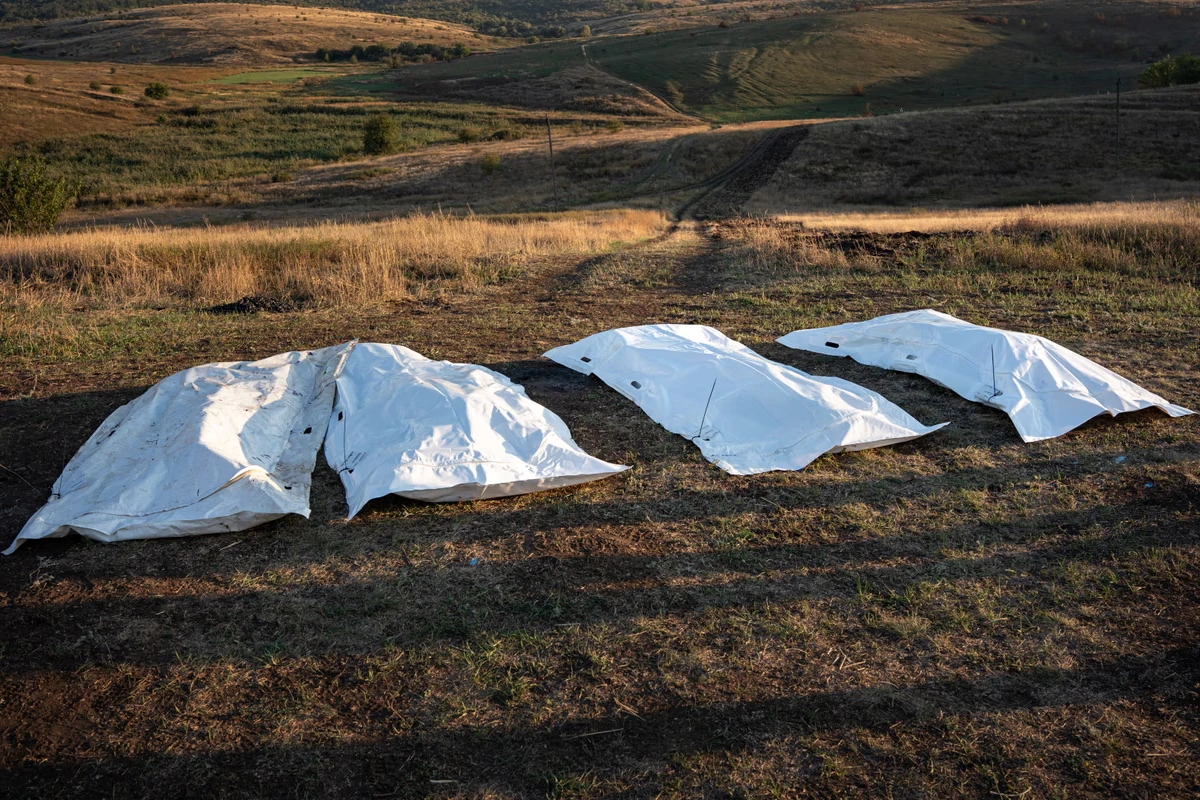
Nearly half a million Russian soldiers have been killed in Ukraine since the start of Vladimir Putin’s invasion more than four years ago, according to a new estimate from the head of the British spy agency GCHQ.
Anne Keast-Butler, the chief of the electronic intelligence agency, said in her first speech in the job that Russian forces were “going backwards on the battlefield” inside Ukraine for the first time since late 2022.
She then offered a new Russian death toll estimate, which was higher than a recent estimate of 352,000, calculated by the exiled media outlets Meduza and Mediazona, who extrapolated their total from official probate records.
Keast-Butler said there was “new intelligence showing that almost half a million Russian soldiers have now been killed since the conflict began”. An exact figure was not given, though the estimate is understood to be close to that total.
Ukraine has been trying to lift the number of Russian soldiers it kills or seriously wounds above Moscow’s ability to raise new recruits in an attempt to halt more than three years of slow losses of territory in the east of the country.
Russian casualties, killed and wounded, have been estimated by the west to be running at around 30,000 a month during April. This month, Marco Rubio, the US secretary of state, said that, of those, 15,000 to 20,000 a month were killed.
The high casualty rates reflect Russia’s continued attempts to capture the eastern Donbas region, as demanded by President Vladimir Putin. Exact recruitment figures are hard to obtain but the economist Janis Kluge estimated Russia was recruiting around 800 to 1,000 a day, between 25,000 and 31,000 a month.
Keast-Butler told an audience at Bletchley Park that GCHQ was “working tirelessly” to degrade and reduce the Russian threat to the UK and in Europe, warning, as trailed a day earlier, that Russia was relentlessly targeting Britain’s infrastructure and democracy.
“One area in sharp focus for us is protecting the data and energy flowing through the critical cables and pipelines in and around British waters – we do this by exposing Russia’s intent, motive and underwater capabilities,” Keast-Butler said.
In April, John Healey, the defence secretary, said a British warship and aircraft had tracked Russian Akula and Gugi submarines trying to survey undersea infrastructure in the north Atlantic, in a month-long operation.
Keast-Butler said “no nation can face these threats alone” then mounted a defence of an 80-year-old UK-US intelligence sharing relationship at a time when the transatlantic alliance has been under acute political strain.
It was, she said, “a powerful and robust partnership that remains fundamental for the security of both our countries”, and the “strongest intelligence alliance in the world”, paving the way for the Five Eyes alliance with the addition of Australia, Canada and New Zealand.
During the the spring, Donald Trump repeatedly voiced his unhappiness with Keir Starmer for not being willing to join the US-Israeli war on Iran launched at the end of February.
Close cooperation continues between GCHQ and its US equivalent, the National Security Agency. The agencies are working together to develop security algorithms able to withstand attacks from ultra-fast quantum computers, which are expected to become operational in a few years.
“Quantum computers will be able to complete, in a matter of seconds, tasks that currently take years,” Keast-Butler said. “That includes defeating the codes and encryption that keeps our secrets safe today. So we must protect our most critical systems from future quantum attacks.”