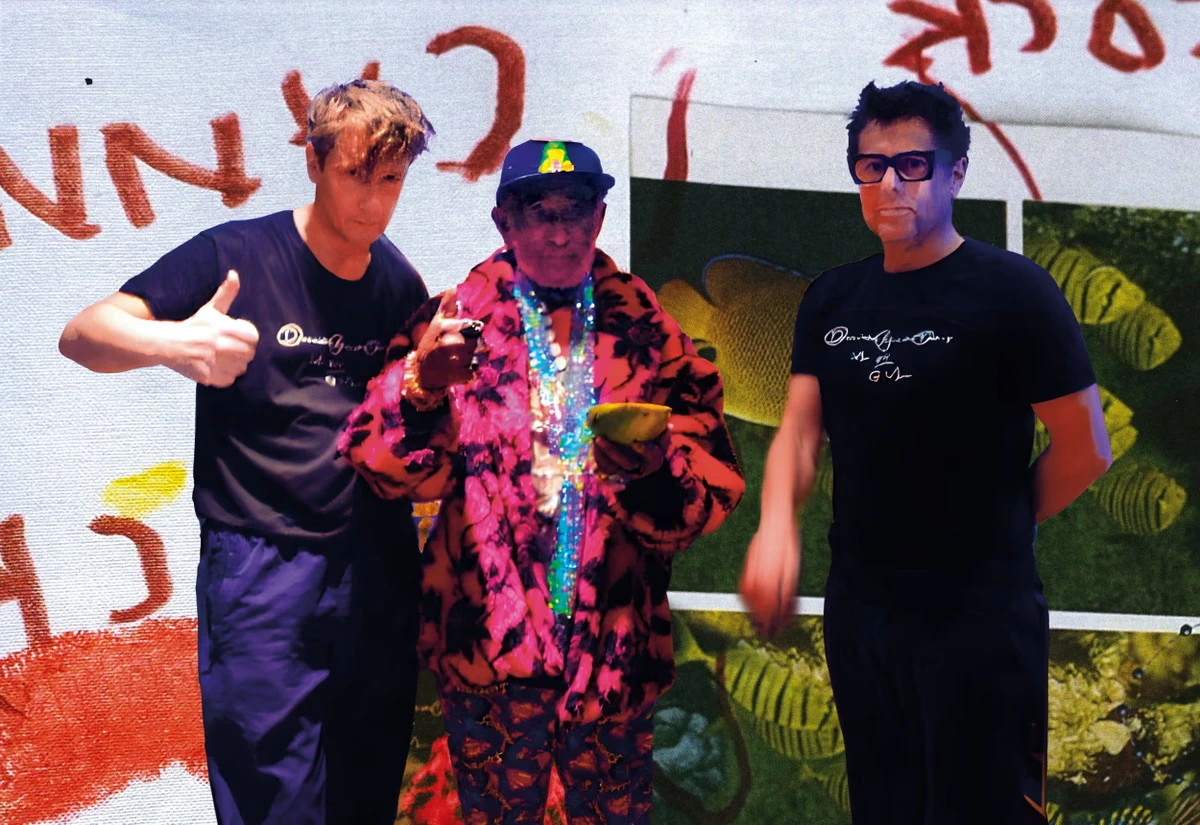
Interviewing Mouse on Mars is no easy feat. Not because the duo are hard to find, even though their current studio is hidden in a courtyard deep in Berlin’s Kreuzberg district. Nor because they continue to be notoriously busy, particularly since one half of the band, Jan St Werner (born Jan Stephan Werner), is now a professor in pop music, at the Folkwang University of the Arts in the western German city of Essen. No, a conversation with Mouse on Mars is an exercise in perseverance and endurance.
Which does not mean it is unpleasurable to chat with Andi Toma and St Werner, as well as their unofficial member and longtime collaborator, the percussionist Dodo NKishi. But any answer to a question may end up somewhere entirely different than originally intended, spanning from the quality of the fruit juice NKishi brought to the studio, to esoteric, tech-optimist digressions on the possibility of forensic resynthesising of the past through archival audio.
Chaos is baked into the very DNA of Mouse on Mars – one of the most influential experimental music projects to have come out of Germany over the past three decades, but also one that was never quite absorbed into or even recognised by the country’s music industry.
Childhood friends, Toma and St Werner, from Düsseldorf and Cologne respectively, were born on the same day, in the same hospital – or so the lore goes. In the early to mid-1990s, they began to experiment with electronic music, releasing their first album, Vulvaland, in 1994 with the British label Too Pure. Numerous other releases followed: studio albums, live albums, compilations, archival releases, and collaborations such as 2007’s Tromatic Reflexxions with Mark E Smith.
Just as eclectic is their sound, which has morphed throughout the 30-plus years of their career: from weird, dubby dance music on Vulvaland; to something akin to “surreal pop” (as Rolling Stone called it at the time) on 2012’s Parastrophics; to post-postmodern orchestral music on Dimensional People from 2018, with contributions from Bon Iver, the National and Beirut; and early AI-experiments in 2021 with AAI. What unites all the different soundscapes is their layers upon layers, glitches and scattered harmonies. They share an aesthetic DNA with musicians such as Boards of Canada, Four Tet and Matmos, and have influenced artists beyond the realm of music – as evidenced by their 2004 exhibition and book project Doku/Fiction: Mouse on Mars Reviewed & Remixed, with contributions from writers, academics and visual artists, including Dietmar Dath and Alice Stepanek and Steven Maslin.
After a five-year silence, they are about to release Spatial, No Problem, a collaboration with Lee “Scratch” Perry recorded during the late dub and reggae legend’s whirlwind visit to their former Berlin studio in 2019, two years before his death aged 85. The meeting had been set up by mutual friends, though it was not clear whether it would really happen until Perry arrived at Berlin’s airport – the former Bob Marley producer had a reputation for unpredictability, and dates kept shifting. The result is a collage-esque fever dream of a record, marrying Perry’s signature free-flowing vocals with a strange, yet warm mix of countless instruments played by friends, all held together by glitchy electronics. They had the idea to record the session as spatial audio, a technology used to mimic a more “natural” hearing experience in 3D. Asking about his familiarity with the technique, Perry answered with a wide grin, and the sentence “Spatial? No problem”. The title to the album was born, which includes recordings that are said to be some of Perry’s last.
It took Mouse on Mars years to engage with the work again. Covid played a role, but there were also the shock of his death, their own self-proclaimed laziness (or rather: business, with them regularly juggling several projects at the same time), previous disputes in regards to the ownership of the material, and, of course, its sheer magnitude. In the four days of Perry’s visit to the studio, they recorded nearly non-stop, with friends and collaborators dropping in and out. “The sessions were quite drawn-out, you could maybe call them unsorted,” Toma says, “but actually, about 70% of what made every song was already there, their structure, the different parts, and who added what, it developed quite organically. We only had to cut around it a little bit.” And off they go on a diversion about the fish soup that was cooked during the recordings, before discussing the energy Perry brought to the space.
Their reverence for Perry is obvious, every attempt to steer the conversation towards other topics brings the trio back to their time with him. Their reverence for Perry is obvious, and every attempt to steer the conversation towards other topics brings the trio back to their time with him. They paint a picture of a creative frenzy: technicians installing microphones whichever corner Perry ended up standing and performing in, friends popping in and out of the sessions, NKishi being proclaimed “God” by Perry in a graffito on the studio’s walls, a general sense of a meeting of minds between artists with a similarly anarchic approach to life and craft.
Our conversation and its sense of order within chaos mirrors this collaborative album, but also their approach to its rollout. In London, Mouse on Mars will celebrate the record with an “immersive installation and unique soundscape” at the The Pit in the Barbican Centre with the aforementioned spatial audio technique. It will be, as the Barbican proclaims, “the only way to experience the album as fully intended”. Asking Toma, St Werner and NKishi – who will join the core duo for two live performances together with the Nigerian-Jamaican-American scholar and writer Louis Chude-Sokei on 5 and 6 June – at the end of April about their plans for the installation of performance seems to lead nowhere: “What are we planning?”, NKishi asks, “it’s the problem with planning again.” Laughing. “We’re currently planning. Or waiting for the plan to find us.”
They are not quite unplanned as they let on, however. Apart from NKishi as a live musician, and Chude-Sokei as a key collaborator on the project (he also added field recordings from the site of Perry’s fabled Black Ark Studios in Jamaica to the mix), there will be a conversations with David Katz, a biographer of Perry’s, and Ayesha Hameed, an interdisciplinary artist discussing Afrofuturism past, present and future. In Berlin, they will be mapping out the spatial audio experience, before installing it at The Pit.
NKishi refills the juice (aronia berry, first pressing), there is no attempt to wind down the conversation. “We don’t want you to leave,” NKishi says laughing. Nobody has quite answered the original question. Nobody seems to mind. At a moment when the music industry is becoming ever more algorithmic, more optimised, more relentlessly targeting fickle attention-spans on social media, Mouse on Mars remain a genuinely anomalous proposition: a band whose greatest asset is their refusal to be legible. And they have been doing this for 30 years, ending up somewhere entirely different than originally planned – and making it sound, against all odds, exactly where they meant to be. After all, the most fascinating things still happen in the moments where no one quite knows what’s going on.