You can judge a woman by the people she surrounds herself with. For the last few months I’ve been talking to the people Marilyn Monroe surrounded herself with, during her eventful 36 years on earth. Ostensibly and primarily, I was doing this to make a radio documentary, which begins on what would have been her 100th birthday. But I also had a secret secondary motive: I wanted to find out if – maybe in another life – Marilyn and I might have been friends.
The first thing to say about Monroe’s friends is that she had a lot of them. The fact that more than six decades have passed since her death, and it’s still possible to find enough living people to interview, tells you something. This is all the more surprising because MM (as she’s sometimes referred to in fan circles) seems far too much the archetypal, immortal screen goddess to do anything as ordinary as have mates. And while it’s possible to imagine her trailed by a harem of pathetically adoring men – like Tom Ewell’s character in The Seven Year Itch – her sex-symbol image means people find it harder to envisage her having real friendships with women.
But Monroe could indeed be what some might call a “girl’s girl”. Amy Greene is an ex-model and the widow of Milton Greene, the photographer with whom Monroe formed her independent film company, Marilyn Monroe Productions (MMP), in 1955. Greene shared her home with the star for several years in the mid-1950s, and remembers the consternation this arrangement caused: “Girlfriends would say, ‘Are you out of your mind to have that woman in your house?’ I’d say, ‘What’s wrong with you? There’s nothing there. They’re business partners!’ And when we got to know each other and we became real friends, I knew that she would never hurt me by banging Milton.”
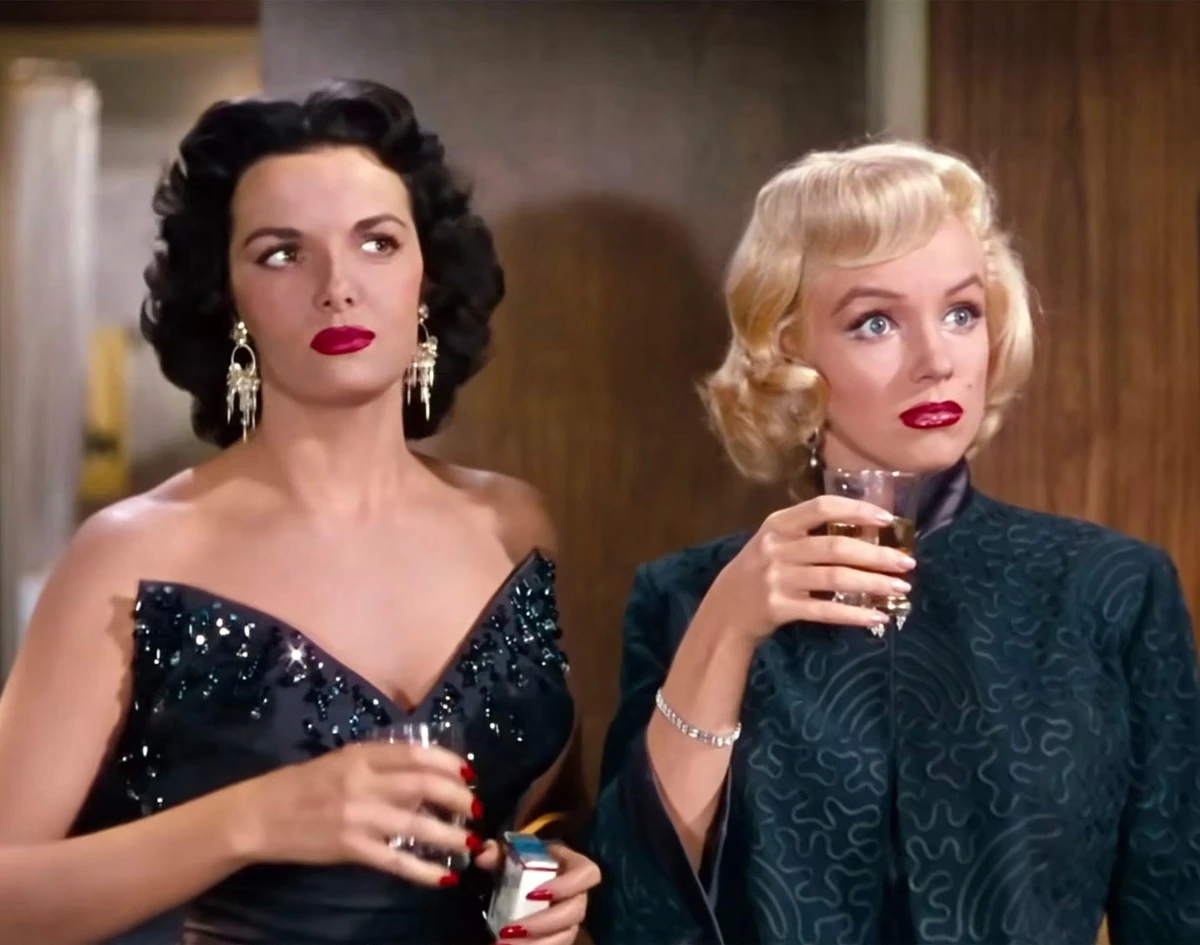
Female friendships figure prominently in her movies, too. She pals around with Lauren Bacall and Betty Grable in 1953’s How to Marry a Millionaire (very much the Charlotte to their respective Miranda and Samantha), and has a close bond with Eileen Heckart’s Vera in Bus Stop – significant, since this was MMP’s first co-production. Perhaps most memorable, though, is Gentlemen Prefer Blondes, in which Monroe co-starred with Jane Russell, a brunette who could vie with her for mid-century sex symbol status.
Monroe was being paid only a fraction of Russell’s £200,000 fee, but despite this contentious setup, the two developed a mutual affection that endured long after filming wrapped. In Russell’s 1985 memoir, My Path and My Detours, she recalls a day at the beach with close female friends: “[We] had wine, music and more talk by the fire … I thought of Marilyn. I wished I had her phone number, because I knew she belonged there, where we were all laughing about our problems.” That was August 1962. The next day Russell received word that Monroe had died.
Marilyn also had relationships with Hollywood contemporaries that were less sisterly. In 1953, Mamie Van Doren, now 95, was contracted as Universal’s “answer to Marilyn Monroe” and she remembers regularly bumping into her sometime rival around town. Van Doren described Monroe to me as “a lovely person [who] didn’t have a bad bone in her body”, but she also has a line in scurrilous gossip – see her latest memoir, You Thought I Was Dead (out on 2 July) – which ranges from the slightly shady (“Everybody thought I was copying her, but it was more or less the other way around”) to the outright unrepeatable-for-legal-reasons. Still, her overriding sentiment was solidarity with another young woman at the mercy of the male-dominated studio system: “We had the same problems; what we were expected to do if we wanted to get a role. And she was more having problems with that than I was.”
As for male friends, everyone’s heard about Monroe and John F Kennedy. Some even allege their dalliance contributed in some way to Monroe’s early death. While JFK may have been the most powerful man in the world, my impression from speaking to her confidants is that his standing in Monroe’s heart was far less significant.
The men who ultimately meant the most to her were her platonic friends and collaborators. Men such as the photographer Lawrence Schiller, with whom Monroe worked on the second most scandalous nude photoshoot of her career. The first was the “red velvet” series, shot when Monroe was young and broke, and later used by Hugh Hefner to launch Playboy (Monroe was never paid a cent more than the initial $50 fee).
The second was all Monroe’s idea, a publicity stunt devised on the 1962 set of her final, unfinished film, Something’s Got to Give, to remind the world – and the studios – of her star power. As Schiller tells it: “Very few people really understand light. Marilyn understood it. This is a woman unsurpassed by any other I’ve come across in the entertainment business … She knew a lot about photography, and she knew what was right for her.”
Another long-term friend was Sam Shaw, the man who took probably the most famous photograph of the star – the one where she is standing above a subway grate in a billowing white dress. In Shaw’s posthumously published book, Dear Marilyn, he credits her “elegance and clean sense of fun” with the shot’s success. Their letters reveal a warm, supportive friendship, rooted in shared artistic passions and hardscrabble childhoods, which eventually grew into a chosen family for Monroe. Shaw’s daughter Edie, who, like Monroe, was born on 1 June, told me about a circus trip with the movie star to celebrate Edie’s 10th birthday and Marilyn’s 29th: “She was a complex person. She would talk in the same sort of language that you’d speak to her. So if it was a child, she was sweet and soft. If it was a studio head, she was tough. She could be many Marilyns.”
Monroe got on well with children and her thwarted desire to become a mother is often cast as central to her tragedy. But Greene believes, based on their kitchen-table chats, that her true feelings were more nuanced: “She loved [to say], ‘Oh, I want children.’ She loved the word ‘children’. But it was a fantasy, and she knew it. She should never have had children. She couldn’t have dealt with them. She was not a housewife-y type.”
Moreover, as the Shaw family’s memories attest, Monroe did have children in her life, and plentiful opportunities to express maternal love. On the day she died she spent time on the phone consoling her former stepson Joe DiMaggio Jr over a recent heartbreak.
Put all these pieces together, and the picture that emerges is very different from the tragic tabloid fable of a lovelorn sexpot who died because the Kennedy brothers spurned her and she couldn’t have a family of her own. The Monroe her friends remember was a joyous, funny, intellectually curious woman, brimming with creative ambition. Anyone would have been lucky to have her as a friend.