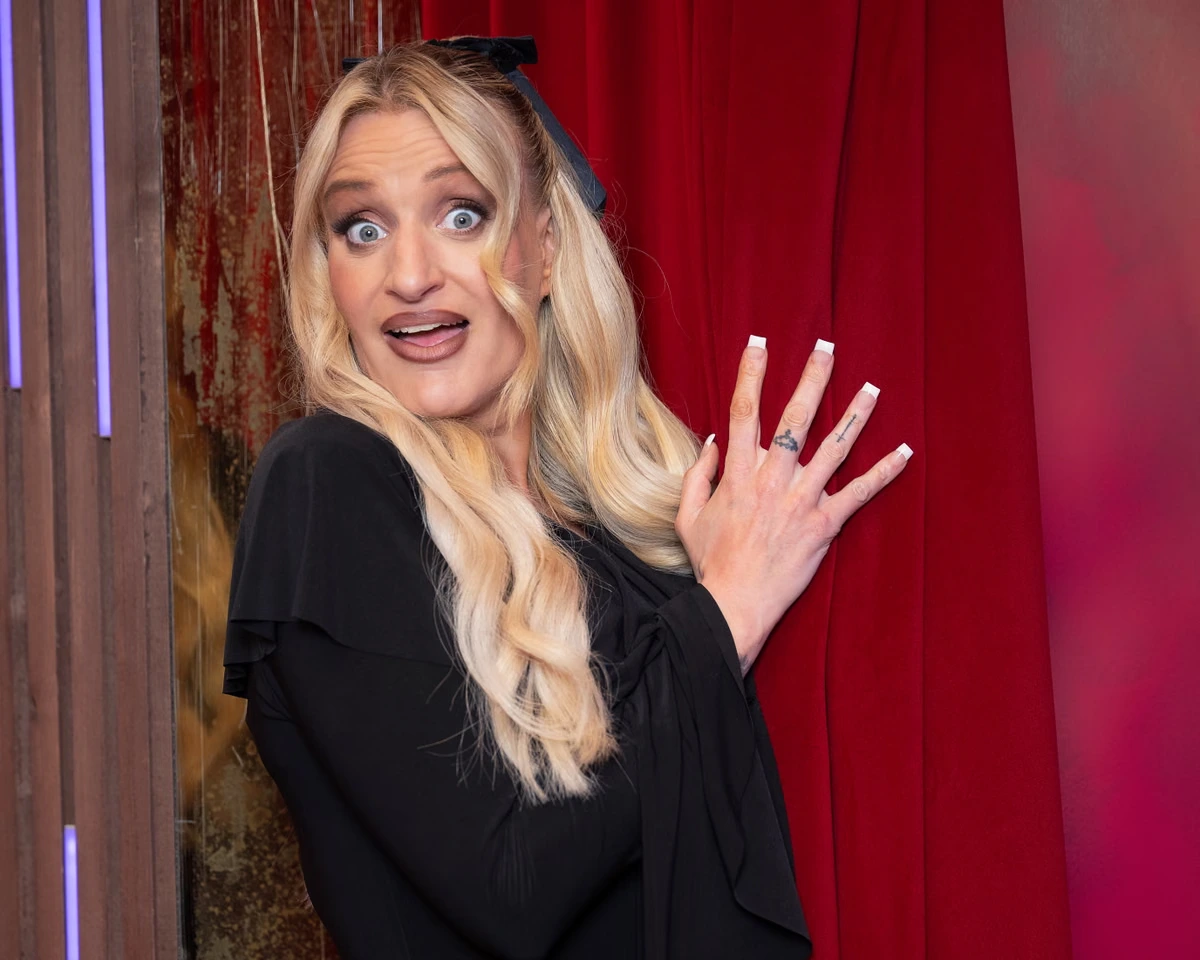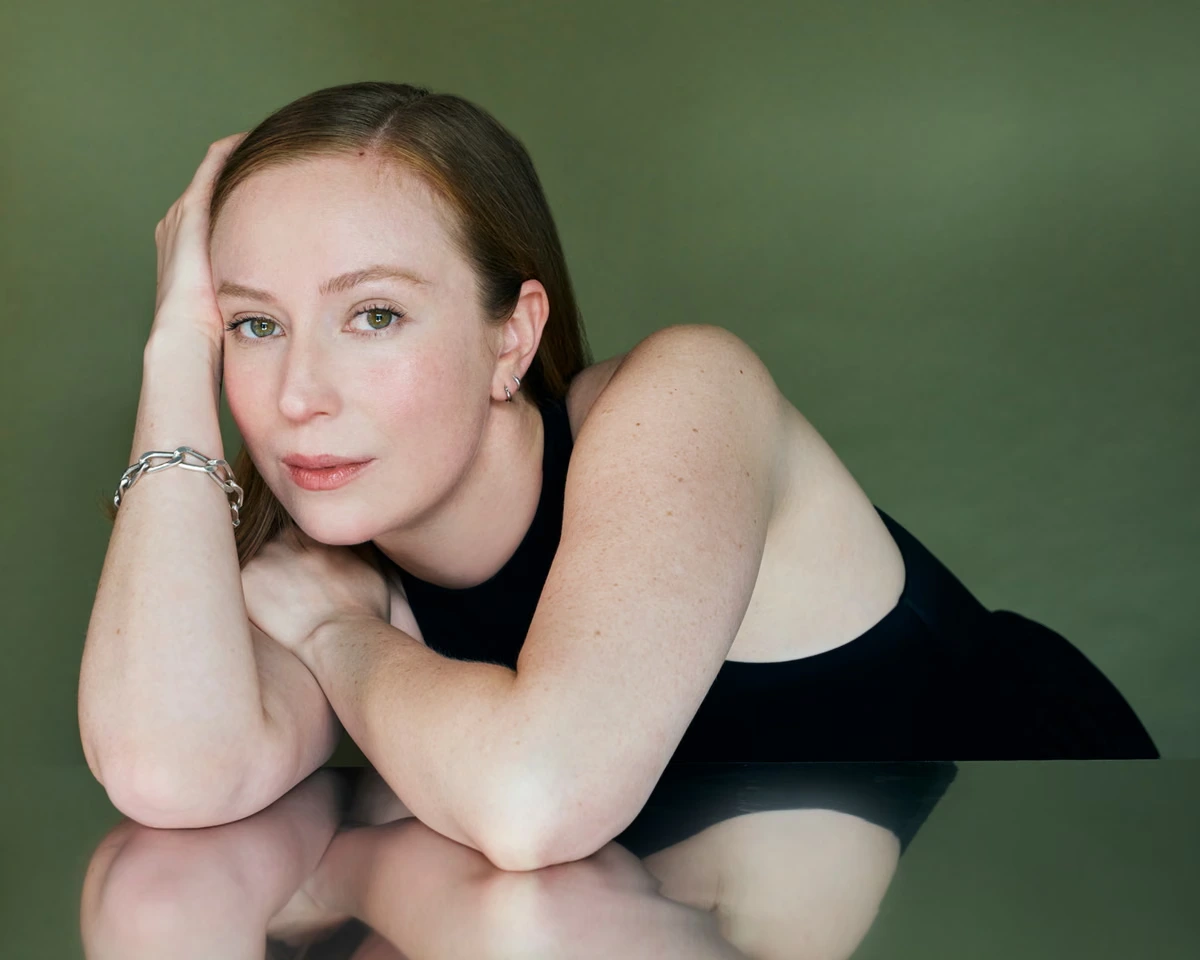
‘God is good all the time,” laughs Hannah Einbinder. She’s fresh off a plane from Los Angeles and curled up barefoot in an armchair. This, she says, is “a crazy time in life. Starring in Teenage Sex and Death at Camp Miasma in the midst of Hacks ending … it’s definitely an embarrassment of riches.”
Hacks is the HBO comedy that ended earlier this year; in May, Teenage Sex and Death at Camp Miasma, Jane Schoenbrun’s queer meta-horror, became the breakout hit of this year’s Cannes film festival.
In the film, Einbinder plays a film-maker, Kris, who becomes consumed by her obsession with Billy Presley, the reclusive star of the original Camp Miasma slasher franchise – played with hypnotic wit and sensuality by Gillian Anderson. What begins as an attempt to persuade Presley to return to the series spirals into an ecstasy of sex, death, VHS tapes and junk food. Scene by scene, the lines between reality and fantasy begin to collapse.
“When my agent sent me the script, I was blown away,” says Einbinder. “Its through-line of confronting shame and dealing with repression and dissociation was intriguing to me.” (It’s a theme Schoenbrun has said was inspired by their own process of learning to embrace sexuality after transition.)
“We’re discouraged from discussing this stuff,” says Einbinder, “but it’s something I’m familiar with. I had to think: ‘How true is this for me?’ Like Kris, I had to mine my own experiences and confront things I didn’t want to see.” The film, she adds, helped her “be more open about desire”. It was also “a roadmap for how it’s supposed to feel and what one should feel comfortable with doing or saying, and when to say no”.
Dressed in a floor-length black dress and a flowing white silk kimono, Einbinder cuts a more glamorous figure than I had expected. On screen, her style and comedy often veer towards the oddball; in person, she is refined, softly-spoken, and deliberately cautious.
Her willingness to sit with discomfort feels characteristic of the actor, whose performances often hinge on the tension between awkwardness and emotional honesty. Schoenbrun has said they cast her in her Teenage Sex and Death at Camp Miasma because they “found her deranged physicality exciting”.
Most immediately significant is Einbinder’s gift for creating electric chemistry with older female co-stars. In Teenage Sex and Death at Camp Miasma and Hacks, she spends much of the time opposite another glamorous and formidable woman.
In the long-running series, Einbinder played Ava Daniels, an aimless comedy writer hired to revive the career of Jean Smart’s Las Vegas standup legend, Deborah Vance. It became one of television’s sharpest comedies, but the key to its emotional force was the relationship between Ava and Deborah: two women who initially seem to have little in common, but who slowly become essential to one another.
Their bond was built on insults, betrayals and power struggles, but also on a profound creative understanding – Ava pushes Deborah to confront what she has become, while Deborah teaches Ava the discipline and resilience she lacks.
The experience of working on the show was profoundly important to her, says Einbinder, welling up. “I learned so much and I became a person – I became myself. I don’t know how I would have become who I am without it.”
She takes a deep breath. “I started comedy because the only way that I could feel good was if I felt like other people felt good. When I was 24 and starting the show, I was just kind of a shell. I didn’t advocate for myself. I didn’t have boundaries. I was passive in a lot of ways.
“I think I was just born without self-esteem. Even neutrality felt impossible, just to be cool with myself, let alone the idea of love for myself. Now I feel incredibly embodied and certain of myself in a way that I never thought was possible. And I do credit a lot of that to my experience working on Hacks.”
It’s hard not to trace a similar trajectory to that of her character in Teenage Sex and Death at Camp Miasma: a woman forced to excavate the parts of herself she would rather avoid, to come out the other side stronger, more self-assured, and committed to advocating for herself and the causes she believes in.
Einbinder grew up in Los Angeles in a progressive Jewish family, where comedy was “the main currency”. Her parents – original Saturday Night Live cast member Laraine Newman and actor Chad Einbinder – were always trying to make each other laugh, and she and her siblings quickly joined in. “That’s certainly the incubator for my approach to interacting with others.”
At university, studying broadcast journalism, she joined an improv troupe and began performing standup at open mic nights. She applied to it the same discipline, she says, that she developed as a competitive cheerleader in high school. “I was determined to risk anything, even falling on my face, if it meant I’d get a moment of satisfaction and approval. Comedy was my way of feeling good – and for the most part, I really didn’t feel good.”
By 2019, she was touring as the opening act for comedian Chelsea Handler, and the following year she made her late-night debut on The Late Show With Stephen Colbert – an appearance that helped her land Hacks, despite having no acting credits. “It was the only thing that I had to show for myself,” she says
The audition, in March 2020, required the character to break down in tears. Einbinder listened to other candidates sobbing through the walls; she had never learned how to cry on command. “I thought, I can’t do the tears, but I could throw in a joke.” It worked; in fact, the gag was such a hit that it made it on to the show.
One of Hacks’ central storylines follows Deborah’s battle to break into late-night TV. It’s also where Einbinder got her break. I wonder what she makes of the current state of American comedy?
“Colbert is gone,” she says, referring to Stephen Colbert’s departure from The Late Show. “CBS has been very clear in their directives. [Jimmy] Kimmel was suspended. There’s no question that these are political choices.” But what is frightening, she adds, is that these figures represent relatively mainstream voices rather than the radical fringe critics often accuse them of being.
“To me, those are not bastions of true leftist thought. They are Democrat with a capital D guys who are, yes, poking fun at the right. But they’re rich white men being axed for pretty centrist and mild speech. So if that’s being censored, that’s a huge problem.”
In recent years, Einbinder has developed a reputation for being one of the most outspoken actors in Hollywood. She has used awards speeches and social media to advocate about the climate crisis, immigration, ICE and the war in Gaza. At the Emmy awards last September, after winning outstanding supporting actress in a comedy series for Hacks, she closed her acceptance speech with a message that became one of the night’s most widely discussed moments: “Go Birds, fuck ICE, and free Palestine!”
She traces that confidence back to college, when Bernie Sanders’ presidential campaign became “a political awakening”. By far the most difficult part of her political journey, she says, was “unlearning” the Zionism she was raised with. “Once I came to understand reality as it was, I just could not bear the idea of not shouting at any time, in any place, about how wrong and violent it was. How deeply it desecrates our people and what our religion is supposed to mean.”
The humanitarian crisis in Gaza “haunts” her, she adds. “I’m just doing what I think is, frankly, the Jewish thing to do, which is to value human life and try to contribute to healing the world.”
She adds: “I am incredibly privileged, because smears of being an anti-Semite don’t stick to me. I’m such a proud Jew. But I’m certain there are community members who hate me for this, many of them in my business, and they won’t work with me and want nothing to do with me.”
Instead of feeling anger, she says she feels a sense of sadness and loss. “I am sad for them. They are trapped in an ideological prison that stops them from seeing other people’s humanity. They’re trapped because of the massive propaganda campaign waged against them since the moment they could understand language.” Her views have cost her familial relationships, too. “I don’t know that they will ever be repaired, but I have found a family elsewhere in the rich anti-Zionist Jewish community.”
For Einbinder, politics is inseparable from lived experience. She is bisexual, has two transgender siblings and speaks about identity not as an abstract debate but as something woven into everyday life. “Everything is personal. Politics is the most personal thing. It’s not theoretical.”
That refusal to separate the personal from the public is, in its own way, what took her into Camp Miasma in the first place. It was her first real chance to leave behind the creative family that had shaped her on Hacks and find out what she could do without them. “I was both excited and intimidated,” she says. “I was just like: ‘Fuck, can I do this? Can I do something that isn’t the safe environment that raised me, with the people who know exactly how to shape and mould me?’” Watching her talk, it’s clear she already has her answer.