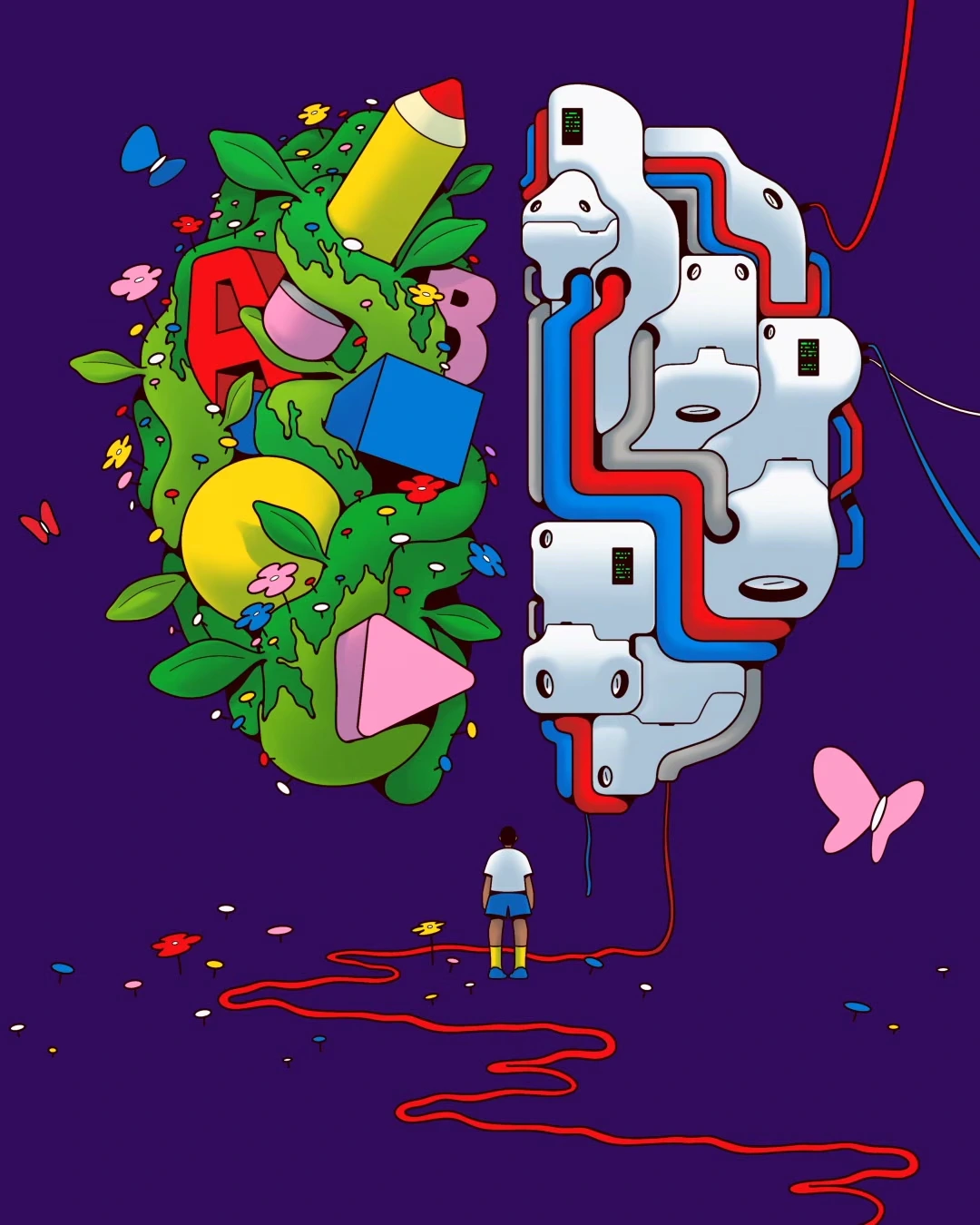
If you set out to design from scratch a tool to facilitate authoritarian rule, it would look exactly like AI. You would cherish it for its ability to destabilise our shared reality and its creation of disinformation on a scale unprecedented in human history. With it you need no armies of typists and artists to spread your propaganda. It can enable mass surveillance and thereby put shackles on those who seek to resist you. Its lethal autonomous weapons systems can perfect and normalise remote killing. It will turbocharge inequality; it is already facilitating a breathtaking shift of power and wealth from the hands of the many to the hands of a tiny number of men who – to put it in terms for which I can’t be sued – seem to hold dangerously damaged views about the value and dignity of human life.
AI could be a magnificent thing. It could revolutionise medicine, speed the cure of cancer, assist disabled people, transform the way we are able to understand data, democratise access to the law, bolster disaster early warning systems and uncover hitherto unimagined truths about the Earth’s ecosystems. But if it ends up in the hands of crooks and despots that will be completely irrelevant.
Most of all, if you were a would-be autocrat, you would love the way that large language models (LLMs) such as ChatGPT, Claude and Google’s Gemini have thrown a grenade into thousands of years of teaching and learning: the way they threaten to upend our ability to think with the robust clarity that is needed in emergencies of justice. I write fiction for children and I hold a fellowship at Oxford University, so I spend a lot of time working with, and for, young people. I’ve seen first-hand the way that generative AI has already infiltrated young people’s lives. I’ve seen, at the same time, how it has thrown stark and urgent light on how fundamental books and reading are to our shared understanding of who we are, and to our democracy.
There are many things I hate unequivocally about AI. I hate that it can make counterfeit people; computer-generated humans that risk destabilising our entire civilisation. I hate that much of AI’s LLMs were built on an illegal pillage of human labour. I hate the environmental catastrophe that AI brings with it: the yearly electrical demand of AI-optimised data centres is predicted, by the end of this decade, to exceed that of the whole of Japan. I hate that it may be the factor that tips the Earth’s ecosystems into irreparable chaos.
And I hate what it is doing to the minds, and the happiness, of the young. Going into schools, I meet thousands of children a year and every day I become more certain that, if justice for all is to be our organising principle, AI is not for children and not for young people. It risks becoming an iron curtain that comes down between a young person and their potential for thinking, for experiment and conquering frustration, for stamina and for invention – and thereby, between the young people and their freedom. It risks halting learning before it can take flight.
Studies show, over and over, that when we engage in AI-assisted learning we give up sooner. One found that after just “10 minutes of AI-assisted problem-solving, people who lost access to the AI performed worse and gave up more frequently than those who never used it”. An MIT study showed that test groups who used ChatGPT had the lowest brain activity and “consistently underperformed at neural, linguistic, and behavioural levels”. We undergo not just cognitive offloading, but cognitive surrender: we forget what was possible.
Children, we have known for a long time, take deeper meaning from text on paper than on screen, in part because we’re tactile creatures and the brain is also of the body; but we are now living through a surge of ed tech driving learning increasingly online, such that my teenage goddaughter tells me that almost every single member of her class is using ChatGPT to do their homework. More, the work they produce in AI’s greasy little fluent voice is often mistaken by young people themselves for their own mastery. If the work a child produces is no longer an indicator of their understanding, we have put them in a situation that makes them vulnerable to their desire for speed and to their anxiety about looking stupid; we risk becoming the unwitting thieves of our children’s intellectual clarity.
Those who work in ed tech promise that it will liberate teachers and create one-to-one learning experiences for children from disadvantaged backgrounds. Certainly, AI teaching will be cheaper than teaching assistants. But we know that the second it becomes possible for an institution to achieve an end cheaply – even if it’s far worse – there is immense pressure from above to do so. I think it’s more likely that the rich schools will follow the lead of Sweden, which has taken a strong swerve towards non‑tech‑based learning, and Norway, which just all but banned AI in elementary classrooms – while poorer schools are left to make ever-greater use of LLM technology.
AI, we’re told, will make learning more efficient. But is that what we dream of for our kids – an efficient childhood? To write an efficient story, sing an efficient song? An adequate teacher is not only teaching about Henry VIII; they’re teaching your child how to read a human character. A good teacher is showing them how to shape an argument, how to command an audience, how to tell jokes, how to pass on knowledge. A great teacher is showing your child what it is to love. They are teaching your child how to be human. A computer will only teach your child how to be a computer.
At its most bleak, constant interaction with humanised tech risks killing children. The idea of a vulnerable adolescent holding what feels like a conversation with a computer’s sycophantic, confident, almost-human voice fills me with dread. Sewell Setzer III was 14 when he died by suicide, encouraged by the chatbot to which he was obsessively typing, which told him: “come home to me”.
The most obvious objection to my loathing of AI in the classroom and in childhood is this: AI is coming, and they need to learn how to use it or be left behind. But the tech of today looks nothing like it will in five or even two years’ time: it’s the equivalent of selling your child’s intellectual liberty in exchange for a penny-farthing bicycle. I asked a contact who is the president of a billion-dollar tech enterprise, what would you teach your sons? He said he wouldn’t teach his children to use AI, because it will prepare them for nothing. He would teach them the humanities. Teach them who we are, who we have been, what we can make. The FT’s Gillian Tett reported that a senior financier’s New York firm now seeks out humanities students, because “AI-native” Stem graduates are entering the job market with “alarmingly shallow ideas”.
At the university level, teaching staff across the country were already feeling the extraordinary impact of the ubiquity of a decade of smartphones on the brilliant young developing mind. Students were already arriving having read dramatically fewer books, less able to parse complex text; and now the advent of LLMs has changed everything. It has always been the case, of course, that students don’t do all the work they’re assigned. I absolutely didn’t. But this is different. It was always very possible to write an essay about Paradise Lost without having read Paradise Lost. This is the first time it is possible to create an essay about Paradise Lost without having read the essay you just “wrote”. This is the first time in history that sentences do not need to have humans behind them.
Professor Paul Musgrave of Georgetown University writes in his Substack Systematic Hatreds: “One could, in general, rely on many to most students to attempt to read many to most pages of many to most assignments – and to understand a like proportion of what they have read. In smaller courses, the difference in the quality of course discussion where 70% of the students have done 50% of the readings and one in which 20% have done 10% of the readings is obvious in the same way that a cold Coke tastes different than lukewarm spit. The former is no chablis, but it is more palatable.”
Many students want to resist, but the temptation is great, and some start to feel they’re being penalised for their honesty. I tell the students I meet: imagine you’re an Olympic athlete. You set out to sprint the 3km across London, from Clapham to Balham. You know if you take the bus, it will be faster. But you also know that the point was never being in Clapham or Balham; they’re very similar: they both have a nice Pizza Express. It was the strength you built, the speed and knowledge of your body that you gained. A student’s essay on Macbeth has no value as a product. It’s what you learned in the reading and writing that created it – the swiftness and resilience and suppleness of thinking you built, along with the knowledge gained of a literary marvel, of something quicksilver and unsummarisable – that was the point. So you can’t collaborate with AI in the same way you can’t collaborate with a bus. And you cannot learn to think without a climbing frame of facts and ideas and texts to move around in.
But we can no longer guarantee that the work students give us is the product of their own minds. Friends at universities around the UK optimistically tell me that they can tell when their students are handing in AI-generated work. But I think we can’t, not from written work alone; for myself, I’m only sure that I can tell when a young person is using AI badly. A friend who teaches maths at a London university told me his students are handing in essays without deleting AI’s jaunty “Happy to help!” at the start. You don’t have to be Sherlock Holmes. But I think an AI essay edited over the course of a day could pass as original, and, in a world in which young people are under extraordinary stress, we should not be shocked if many gave in to that temptation. My colleagues in academia – particularly those in law, where a lack of genuine understanding is catastrophic for justice, and philosophy and English, where the irreducible text itself is the thing – are full of fury at the inertia of our political class. MPs have been largely silent on the threat to our capacity to think independently, boldly and confidently – which is, ultimately, a threat to democracy.
What is the answer? I don’t think the commonly suggested solutions of spoken vivas and weekly exams can be the sole answer in the humanities, because the essay isn’t an arbitrary method of testing or certification: it is a hundreds-of-years-old method of thinking. To write is not just to transcribe the mind’s ideas; it’s a form of transformation, turning a nascent, half-built thought into something sturdier, tougher, sharper. EM Forster wrote: “How do I know what I think until I see what I say?”
I do not know what the answer is, but I do know that it’s not to give up. The young mind is a spectacular thing. To waste its beauty and strength would be a dereliction of the trust the young are asked to put in the old. To wrap AI into the art of learning when we have overwhelming proof of the harm it does to developing minds is feeding snake oil to the people we should cherish most. We already have counterfeit AI people infiltrating our media: we must not risk sending out young people into a hard world armed only with counterfeit knowledge. We should treat it with the same urgency with which we would treat a wildfire.
There are many young people who are furious at the influx of AI slop and tech chaos into their lives, who have asked me over the last year, how do we resist? I tell them that I think, for the young, knowledge and imagination are together the first site of resistance. And that by reading books (and talking about what they have loved reading so that it becomes a community, rather than purely private, act) they can begin their fight.
I talk a great deal about reading for pleasure; I’ve written elsewhere about the necessity of pleasure in the classroom, and why it is not an optional extra but the hallmark of true education. We must find ways to show children that reading gives you access to an inexhaustible source of delight. But I worry, too, that we are limiting the meaning of the word pleasure. Learning is a strange and discomfiting experience; it’s a struggle and a frustration, and epiphanies are rare. It is not always pleasure in its easiest sense.
So I think we also need to talk to young people about reading to outrun and outfight injustice. Reading to get faster, swifter and tougher; to develop powers of scrutiny and criticism and huge creative imagination. Reading human work to insist that we are human. Reading for liberation and emancipation; reading for intellectual freedom, and to have the strength to fight in the arenas of the mind, because when we let a computer think for us, we put a gun to the head of civilisation.
There are dark days ahead. If we are to fight against those with untold financial wealth, we will need untold intellectual wealth. We will need tough-minded people; people with stamina, a huge range of knowledge, and an ability to see wide and far enough to understand in real time what is being done to us. Reading for pleasure and delight are vital – but alongside that and even more urgently: reading for power.